The Biblical Cosmology — The Model Explained
Introduction
What follows is a description of the cosmological model presented in Scripture. It is not a reconstruction. It is not a hypothesis. It is the model that the text describes, that the translators preserved, and that the believers who received and carried that text understood for two thousand years.
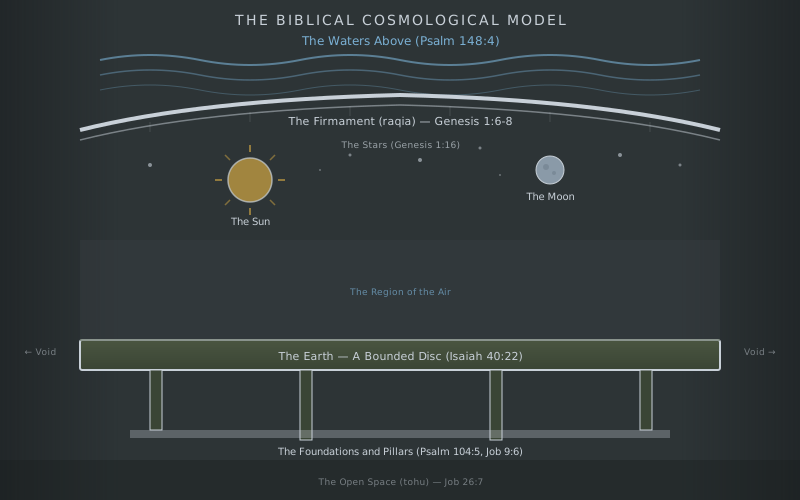
The model is simple. It can be described in a single sentence: the earth is a flat, bounded disc, supported by foundations, crowned by a solid firmament in which the sun, moon, and stars are set, with waters held above and void beyond the edges.
Everything that follows is an elaboration of that sentence.
I. The Earth — A Bounded Disc
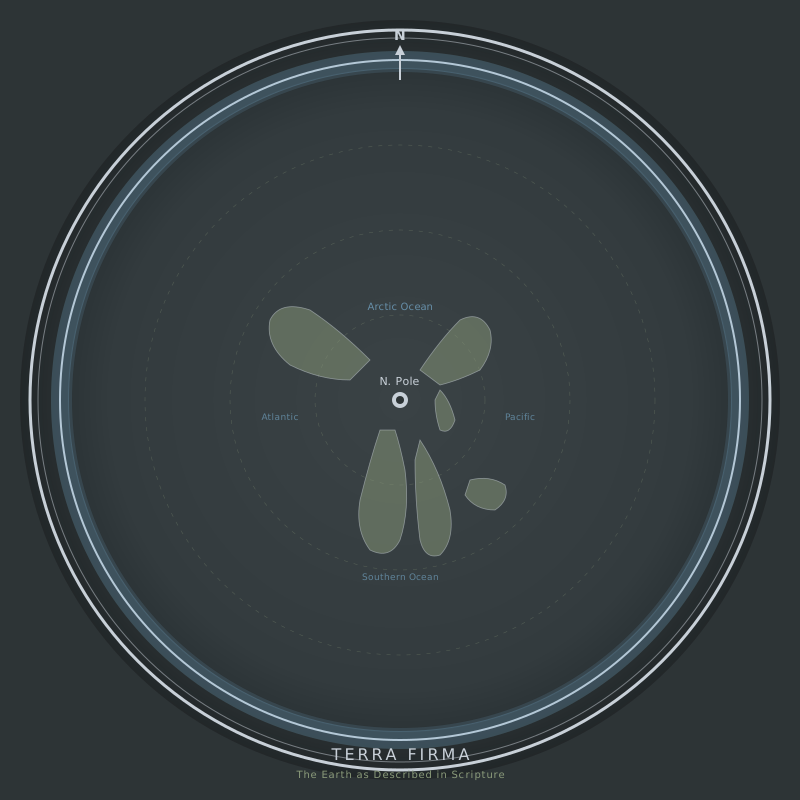
The earth in the biblical model is a flat, circular expanse. It is not infinite in extent. It has a center — the North Pole — and it extends outward to a rim or edge where the disc meets the surrounding void.
The "circle" of Isaiah 40:22 is the shape. The "ends" of Job 38:13 are the edges. The "four corners" of Revelation 7:1 are the four extremities of that bounded plane. The "compass" of Proverbs 8:27 is the tool used to draw the boundary.
The disc is not featureless. It has geography — mountains, rivers, seas, dry land — but it is a surface, not a curve. The inhabitants "stand" upon it (Job 38:14) as a garment drapes over a frame. They do not cling to it. They do not orbit it. They stand on it, and it does not move.
The North Pole is the center. This is not an arbitrary choice. The "North" is stretched out over the void (Job 26:7). The heaven "turns about the North pole" (Geneva marginal note, Job 26:7). The pole is the axis around which the celestial sphere rotates, and it is the fixed point at the center of the disc.
II. The Firmament — The Vault Above
The firmament (rāqîa) is the structure that separates the waters below from the waters above. The word is derived from rāqāh — "to beat out, to spread thin" — the action of a metalworker hammering a sheet of metal into a thin, broad expanse. The image is of a hammered vault, a solid canopy stretched above the earth.
This is the "heaven" of Genesis 1:8. It is the structure in which the sun, moon, and stars are placed (Genesis 1:14-17). It is the "windows of heaven" that open during the flood (Genesis 7:11). It is the "highest heavens" above which the waters reside (Psalm 148:4).
The firmament is not the atmosphere. The atmosphere is the region of air within the firmament — the space between the earth's surface and the vault. The Geneva translators called it "the region of the air, and all that is above us." The firmament is the boundary of that region. Above it is a different domain entirely.
The firmament has a function: it holds back the waters above. It is a barrier, a dam, a lid. The waters above are not evaporated water waiting to condense. They are a body of water held in a reservoir above the vault, sustained by divine authority. When the structure is breached — as in the flood — the waters come down.
III. The Waters — Above and Below
There are two bodies of water in the model.
Below the firmament: the seas, the rivers, the "great deep" (tehom). These are the waters of the earth's surface. They are familiar. They are the waters of Genesis 1:9-10, gathered into their places when the dry land appears.
Above the firmament: the "waters above." These are not clouds. They are not water vapor. They are a body of water — a reservoir — held above the vault. Psalm 148:4 places them "above the heavens." Job 37:18 speaks of God binding "the waters in a cloud" — but the binding is the act of holding them in place, not of forming them from evaporation.
The Geneva translators understood this. Their marginal note on Genesis 1:7 describes the waters above as "upheld by God's power, lest they should overwhelm the world." That is the language of a held-back flood, not a hydrological cycle.
The theological significance is direct: the same power that holds the waters above is the power that sustains everything else. The firmament does not hold by its own strength. It holds because God commands it to hold. The earth does not float by its own mass. It is established by its Maker.
IV. The Celestial Sphere — Sun, Moon, and Stars
The sun, moon, and stars are placed "in" the firmament (Genesis 1:14-17). They are not distant nuclear furnaces billions of miles away. They are lights set into the vault, at a finite distance above the earth.
The sun is a lamp. It is the "greater light" (Genesis 1:16). It moves across the face of the firmament in a daily arc, producing day and night not by the earth spinning beneath it, but by the sun's own motion above the disc. When the sun is above your portion of the disc, it is day. When it has passed beyond the edge, into the void, it is night for you.
The moon is the "lesser light." It moves in the same vault, at a different distance or on a different track, and it reflects the light of the sun. Its phases are the result of its position relative to the sun and the observer.
The stars are the "stars" — the fixed lights set in the firmament (Genesis 1:16). They are the "morning stars" that sang when the foundations were laid (Job 38:7). They are distant, but not incomprehensibly so. They are part of the structure, not outside it.
The "heavens of heavens" (Deuteronomy 10:14, 1 Kings 8:27) refers to the layers of the vault itself — the firmament has depth, and the celestial bodies are set at different levels within it. The "highest heavens" of Psalm 148:4 is the upper boundary of that layered structure, above which the waters reside.
V. Day, Night, and the Seasons
Day and night are produced by the sun's motion above the disc. The sun rises at one edge (the "east" — the side where light first appears, Job 38:12) and sets at the other (the "west"). The arc it traces across the firmament is the path of daylight. The period when the sun is beyond the edge, in the void, is night.
This is not a small lamp moving in a circle above a table. The scale is vast. The firmament is enormously distant. The sun is enormously large. But it is finite. It is set. It moves. It does not require the earth to spin to produce the alternation of light and dark.
The seasons are produced not by an axial tilt of a spinning globe, but by the sun's arc shifting north and south over the course of the year. In summer, the sun's arc is higher and longer — more daylight, more direct light. In winter, the arc is lower and shorter — less daylight, more oblique light. The disc does not tilt. The sun's path changes.
This is the model described in Ecclesiastes 1:5: "The sun ariseth, and the sun goeth down, and in his place he seeketh again." The sun goes down. It seeks again. It is a moving body, tracing a path, returning to its starting point. The text does not say the earth turns. It says the sun goes.
VI. The Foundations and the Pillars
The earth is not floating. It is not orbiting. It is not suspended in a gravitational field. It is built.
It has foundations (Psalm 104:5, Job 38:4). It has pillars (Job 9:6, Psalm 75:3). It has a corner stone (Job 38:5). It was "laid" (Psalm 104:5, Isaiah 45:18). It was "established" (Psalm 75:3, Psalm 93:1, Isaiah 45:18).
These are the language of construction. A foundation is what you build upon. A pillar is what supports from below. A corner stone is the first stone set in a wall — the reference point from which all others are measured. The earth was built like a structure: a base, supports, a surface, a boundary.
"Established that it cannot be moved" is not a metaphor for stability. It is a statement of physical fact within the model: the earth is fixed. It does not drift. It does not spin. It does not wobble. It is where it was placed, and it stays there.
VII. The Void — Beyond the Edge
Beyond the edge of the disc is the "open space" (tōhû) of Job 26:7. The "empty place." The "nothing."
This is not interstellar space. It is not a vacuum filled with galaxies and dark matter. It is the absence of the created order. It is what surrounds the bounded world — the nothing that the foundations keep at bay.
The earth is "hung" or "suspended" over this void (Job 26:7). Not floating in a medium. Not orbiting through a field. Suspended over the nothing, held in place by the same power that holds the waters above.
The "ends of the earth" (Job 38:13, Deuteronomy 33:17) are the boundary between the created order and the void. Beyond them, there is no more earth. There is no more structure. There is the open space, and the silence of it.
This is why the "ends" are mysterious. They are not distant continents. They are not the far side of a sphere. They are the edge of everything.
VIII. The Model in Summary
The earth: a flat, bounded disc, centered on the North Pole.
The firmament: a solid vault above the earth, in which the celestial bodies are set.
The waters: below (seas, rivers) and above (a held-back reservoir).
The sun: a lamp moving across the face of the firmament, producing day and night by its own motion.
The seasons: the sun's arc shifting north and south over the year.
The foundations: the supports beneath the disc, fixing it in place.
The void: the nothing beyond the edge, where the created order ends.
This is the model. It is not a guess. It is not a metaphor. It is what the text says, what the translators preserved, and what two thousand years of believers understood.
Further Reading
The Flat-Earth Bible (full passage index)
Original language word studies: rāqîa, chûgh, tōhû, chawm, tehom
Church Fathers on the form of the earth
Medieval cosmological illustrations (Bible Blackletter, Hereford Mappa Mundi, etc.)
The Geneva Bible (1560) — full text with marginal notes
This model is not complicated. It does not require a university degree to understand. It does not require a telescope. It does not require a satellite. It requires only the text, the original languages, and a willingness to read what is actually written rather than what is assumed to be written.
The model has been set aside not because the text changed, but because the reading of the text changed. The words are the same. The interpretation is not.
Look at the model. Look at the text. Ask yourself which one you are actually reading.